
Flat vs Pitched Roof in Ireland: Which Lasts Longer?
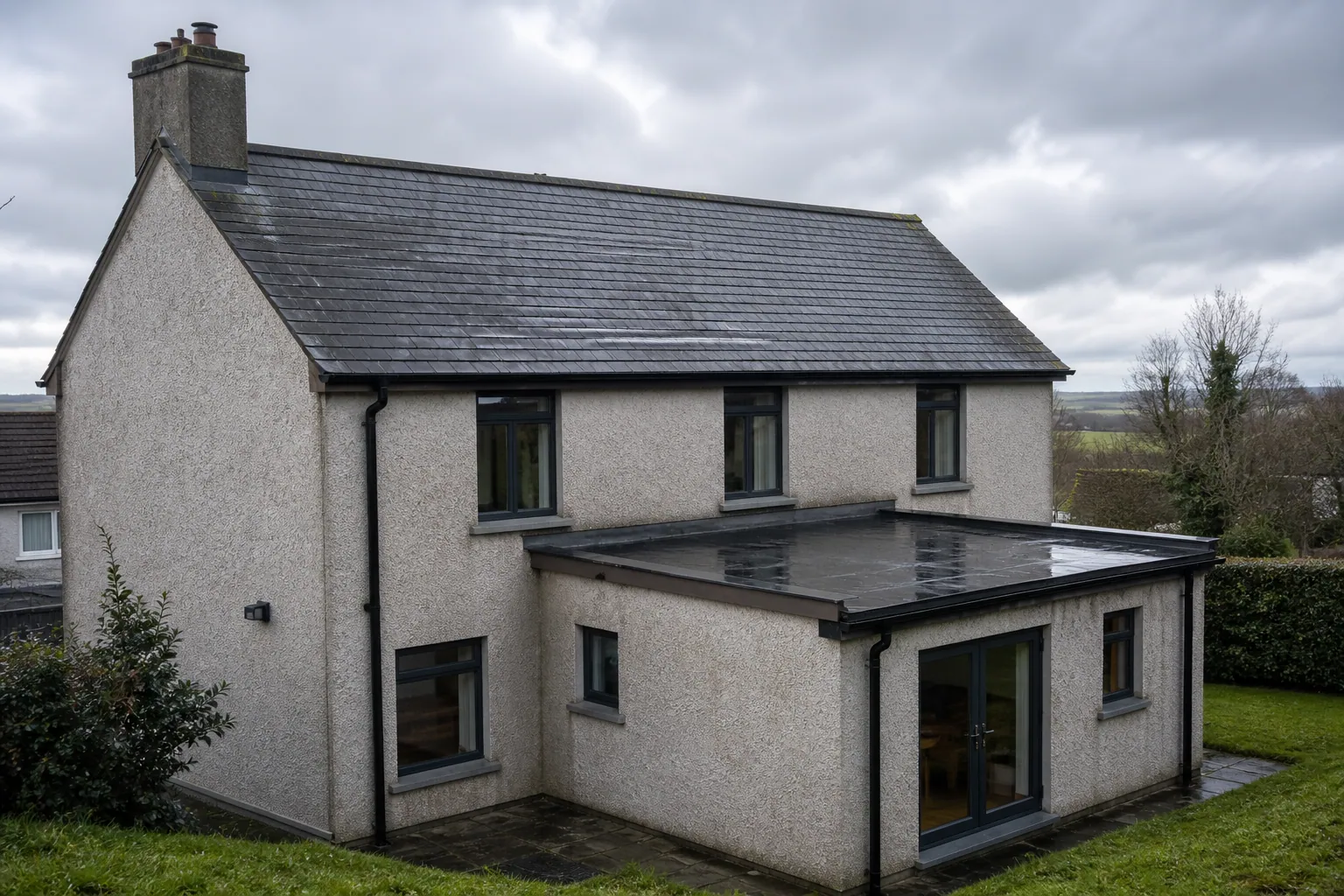
If you are planning an extension, replacing a garage roof, or re-roofing a house, this is the decision that shapes the next thirty years of maintenance. The short answer: in Ireland's wet, windy climate, a well-built pitched roof in slate or tile will usually outlast any flat system, but modern flat-roof materials have closed the gap, and for extensions they are often the right call. The detail matters, so here it is.
Flat roof materials compared
EPDM rubber
A single-ply synthetic rubber membrane, usually fitted in one sheet with few or no seams. Properly installed EPDM typically lasts 25 to 40 years, handles standing water better than older systems, and flexes with temperature rather than cracking. It is now the most common professional choice for Irish extensions and garages. Indicative cost: €80 to €120 per square metre installed.
GRP fibreglass
A glass-reinforced plastic shell formed on the roof. Seamless when done well, hard-wearing to walk on during maintenance, and typically good for 20 to 30 years. Its weakness in Ireland is workmanship sensitivity: GRP hates being laid in damp or cold conditions, and a rushed job delaminates. Choose the contractor before you choose the system.
Torch-on felt
The traditional option, and still the cheapest up front. Modern mineral-finish felt systems are far better than the sheds of the 1980s, but felt remains the shortest-lived of the three (typically 10 to 20 years) and the most dependent on perfect joints. For a budget garage roof it can make sense; for a warm extension roof over a kitchen, the savings rarely justify the shorter life.
Pitched roof materials compared
Natural slate
The benchmark. Good slate on a sound structure routinely lasts 75 to 100 years or more, which is why so many Victorian and Georgian Irish roofs are still original. It is also the most expensive option: indicative €12,000 to €20,000 or more for a full 3-bed semi re-roof.
Concrete tile
The workhorse of Irish estates from the 1960s onward. Expect 40 to 60 years, easy repairs, and the best value for money: indicative €8,000 to €14,000 for a full re-roof on a typical semi.
Clay tile
Long-lived (60 years plus) and attractive, but less common in Ireland, so both materials and experienced fitters cost more. Mostly seen on period properties and higher-end builds.
How Irish weather changes the equation
Rainfall volume. Much of Ireland sees rain on well over 200 days a year. Water finds every weakness, and on a flat roof it moves slowly, so falls (the slight slope) and outlets matter enormously. Ponding water shortens any flat system's life.
Atlantic wind uplift. Western counties in particular see repeated severe wind events. Pitched roofs shed wind well when slates and tiles are properly fixed, but ridge lines and verges are vulnerable points. Flat roofs fail at edges and upstands under uplift, so edge detailing is everything.
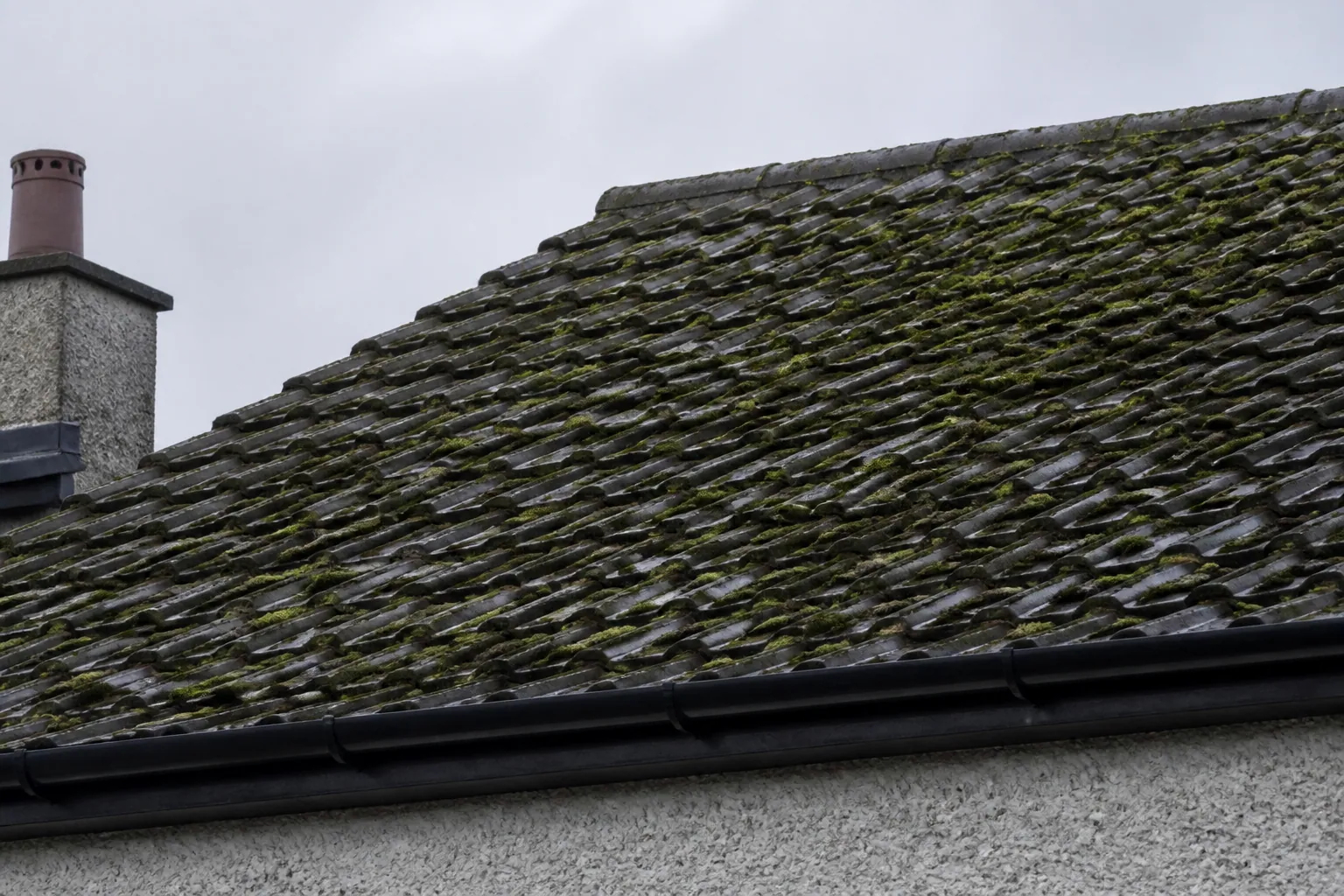
Moss and algae. Our mild, damp climate grows moss on almost any north-facing pitched surface. Moss holds moisture against the roof and blocks gutters when it washes down. It is a maintenance issue rather than a structural one, but ignoring it for years shortens a roof's life.
Freeze-thaw. Less severe than in continental Europe, but winter freeze-thaw still opens cracks in felt and mortar, which is why older felt flat roofs and sand-and-cement ridge pointing fail gradually.
Maintenance schedules compared
Flat roofs need an inspection twice a year: clear outlets and gutters, check for blisters, cracks or lifting edges, and look at upstands and flashings. This is quick, but it must actually happen. A flat roof that is never inspected is a leak waiting for heavy rain.
Pitched roofs need less frequent attention but bigger jobs when they come: moss removal as needed, slipped slates or tiles refixed promptly, ridge repointing every decade or two, and valley checks. All of this is professional work at height; from the ground, our ground-level inspection guide shows what you can safely keep an eye on yourself.
Cost over 30 years (indicative)
| Option | Installed cost (typical) | Likely interventions over 30 years | Honest verdict |
|---|---|---|---|
| Felt flat roof | Lowest (under €80 per m² typical) | One full renewal likely | Cheap twice is expensive |
| EPDM flat roof | €80 to €120 per m² | Inspections, minor flashing repairs | Best flat value if fitted well |
| GRP flat roof | Similar to EPDM or slightly higher | Minor repairs if laid well | Excellent, workmanship-critical |
| Concrete tile pitched | €8,000 to €14,000 (semi) | Moss control, repointing, occasional tiles | Lowest lifetime cost on a house |
| Natural slate pitched | €12,000 to €20,000+ (semi) | Occasional slate refixing | The hundred-year roof |
Verdict by use case
- Kitchen or living-space extension: EPDM or GRP flat roof from a proven installer, or a pitched lean-to if height and planning allow. Insist on seeing previous local jobs.
- Garage or shed: EPDM if budget allows, felt if it does not.
- Full house re-roof: pitched, in concrete tile for value or slate for longevity. A flat main roof on a house is rare in Ireland for good reason.
- Period property: slate, and check whether planning or conservation rules apply before changing anything.
Whatever you choose, the material is only half the decision. The installer is the other half, and our guide on choosing a roofer walks through the checks. For budget planning, see what a new roof costs in Ireland.
Compare roofers: Find a roofer in your county. Directory inclusion is not a FixMyRoof endorsement.
Related questions
Can a flat roof cope with Irish rain?
Yes, if the falls are correct, outlets are generous and the covering is a modern system like EPDM or GRP. Problems come from poor falls, blocked outlets and old felt, not from flat roofs themselves.
Is EPDM better than felt?
For most Irish jobs, yes. EPDM typically lasts twice as long, has fewer seams to fail, and tolerates ponding better. Felt's only real advantage is a lower up-front price.
How do I stop moss on a pitched roof?
Keep gutters clear so moss that washes down does not block them, and have heavy growth removed professionally rather than pressure-washing it yourself. Pressure washing strips the surface of tiles and forces water under them.