Fascia and Soffit Replacement Costs in Ireland (2026 Guide)
The fascia and soffit boards along your roofline hold your gutters up, keep weather and birds out of the roof space, and let the attic breathe. When they fail, the guttering usually goes with them. This guide compares the material options, gives indicative Irish costs, and shows what a proper replacement quote should contain.
A quick note on safety: checking your own fascia and soffit means looking up from the ground, nothing more. The boards sit at the eaves, so any close inspection or repair is work at height and belongs to a contractor with proper access equipment.
What fascia and soffit actually do
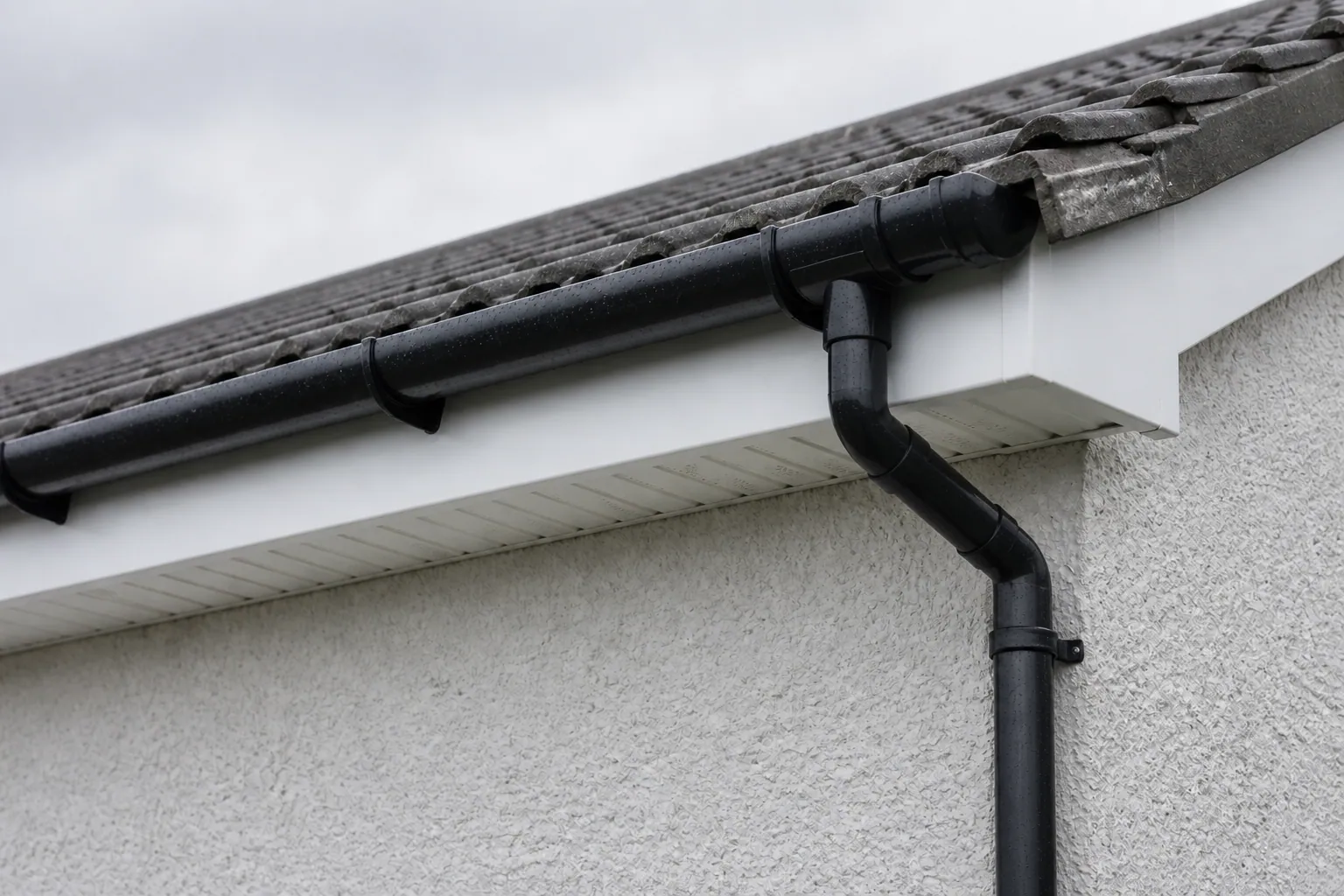
The fascia is the vertical board running along the lower edge of the roof. The gutters fix to it, so it carries real weight when gutters are full of rainwater. The soffit is the horizontal board underneath, closing the gap between the fascia and the wall. Soffits usually carry ventilation slots or grilles that allow air into the roof space. Together with the bargeboards on gable ends, they are called the roofline.
Not every roof has an enclosed soffit. Open eaves can be part of the original design and may ventilate differently. The relevant check is whether the roof has the ventilation path its construction requires. An enclosed soffit also helps keep birds and weather out.
Typical failure signs visible from the ground: peeling or flaking paint, boards that look soft or swollen, wasp or bird activity at the eaves, gutters pulling away, and staining on the wall beneath. Our guide on spotting gutter damage from ground level covers the inspection routine.
Material options compared
uPVC
uPVC is an option for low-maintenance roofline boards. It does not need the repainting that timber does, but suitability and service life depend on the product, fixing, exposure and installation. Ask for the manufacturer's specification and maintenance instructions. Our related question on PVC fascia lifespan covers the factors to discuss with an installer. The appearance may not suit every period property.
Timber
Timber can suit older and period homes and may be repairable in sections. Its condition depends on keeping protective finishes maintained and dealing with persistent damp. Repainting intervals depend on the coating and exposure. If existing timber is sound, a contractor may propose capping it with uPVC; the condition underneath needs checking first.
Aluminium (the premium option)
Aluminium is another option. Compare the specified finish, suitable fixings, coastal-exposure limits, appearance and price with the alternatives. Ask whether the installer has experience with the particular system.
Capping over versus full replacement
This is the decision most quotes quietly hinge on. Capping over means fixing thin uPVC boards over the existing timber. It is faster and cheaper because there is no strip-out, and it is legitimate where the timber underneath is genuinely sound and dry. Full replacement removes the old boards entirely, exposing the rafter feet so any rot can be seen and dealt with before new boards go on.
The risk with capping is that soft timber gets sealed in, where it continues to rot unseen until the new boards start to sag. If a contractor quotes for capping without checking the condition of the existing timber, treat that as a warning sign (see how to choose a roofer).
At the eaves
At the gable end
- 1 Fascia
- The vertical board at the lower roof edge, behind the gutter.
- 2 Soffit
- The underside between the fascia and the wall.
- 3 Gutter
- The channel collecting water from the roof edge.
- Bargeboard
- The board following a sloping edge at a gable end.
AI-assisted explanatory diagram. Not to scale or an installation detail; fixings, ventilation design and concealed layers are omitted. Inspect only from a safe ground-level position.
Terminology checked against the Freefoam technical manual on 31 August 2026. Original diagram, not a reproduction of the manufacturer's drawing.
What replacement typically costs in Ireland
These are internal editorial estimates from Appendix A, not a measured market survey or quotations. Access, scaffolding, house size and the specified work can change the cost:
| Job | Typical range | Notes |
|---|---|---|
| Full fascia and soffit replacement, 3-bed semi (uPVC) | €2,000 to €4,500 | Scaffolding or access tower often priced separately |
| Full gutter replacement done at the same time | €600 to €1,200 extra | Combining both jobs usually saves on access costs |
| Detached or larger houses | Above the range above | More linear metres, more corners, more access time |
Compare itemised local quotes: access arrangements and the work actually included matter more than a general county comparison. Combining tasks can share access costs, but ask for separate scopes before assuming a saving.
What a proper quote should include
An itemised written quote for roofline work should state:
- Access method (scaffolding, tower or other) and whether it is included in the price
- Full replacement or capping over, stated explicitly
- Removal and disposal of old boards and gutters
- Material specification (board thickness, brand or standard, colour)
- Ventilation provision in the new soffits
- Whether new guttering is included or priced separately
- The guarantee, in writing, including what it covers and for how long
- Payment schedule. A modest deposit for materials is common on larger jobs; be wary of demands for most of the money up front
Lifespan and maintenance
Follow the chosen system's cleaning and inspection instructions. Timber needs attention to its protective finish; metal systems need coating and fixing checks. No material has a guaranteed lifespan regardless of installation or exposure. Overflowing guttering can keep the roofline wet, so our guide to gutter cleaning frequency is relevant whichever material you choose.
The insulation connection
If you are having attic insulation fitted or topped up, the roofline matters more than most people realise. Thick insulation must not block the ventilation path at the eaves, or condensation can build up in the roof space. When new soffits and insulation are planned around the same time, tell both contractors, and ask how eaves ventilation will be kept clear. Attic insulation may qualify for an SEAI grant; see SEAI roof insulation grants for the current position.
Compare roofers: Find a roofer in your county. Directory inclusion is not a FixMyRoof endorsement.
Related questions
How long do uPVC fascia boards last?
Service life varies with the board specification, installation, exposure and maintenance. Ask the installer to distinguish a product warranty from an expected service life and to check the timber and fixings behind any proposed covering.
Should gutters be replaced at the same time as fascia?
Ask the installer to assess gutter condition and whether the existing parts can be refitted reliably. Shared access may reduce duplicated work, but replacing serviceable gutters solely because of age is not automatically necessary. Compare itemised prices for retaining and replacing them.
Is capping over old timber ever a good idea?
It can be, where the existing timber is confirmed sound and dry by physical check, not just a glance from a ladder. If the timber is soft, swollen or more than a few decades old, full replacement is the safer spend.